
Semi Truck Won’t Start Cold: Winter No-Crank and Slow-Crank Problems Explained
Charlotte winters are mild until they aren’t. A truck that fired right up all fall can leave you sitting in a yard in Matthews the first morning it drops below freezing. Cold shows up every weak spot in the starting and air systems at once. Here is what goes wrong, what you can check before you call, and what needs a shop.
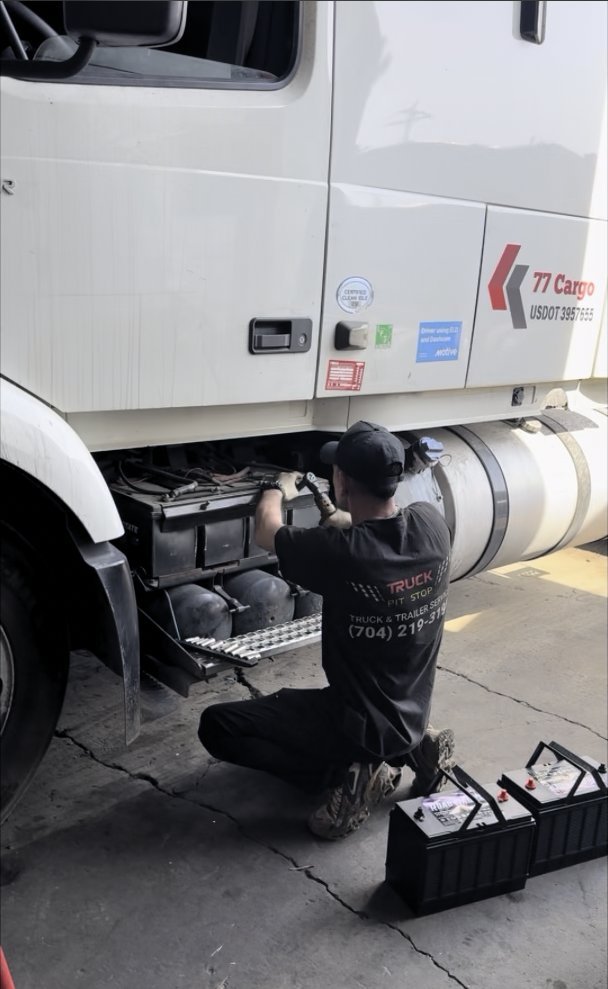
Why cold mornings turn a small problem into a no-start
Cold oil makes the starter work harder. Cold batteries deliver less current. Cold fuel is harder to light, so the glow plugs or intake heater have to do their job. If any one link in that chain is marginal, the first cold morning is when it fails. Start with how the truck behaves when you turn the key.
Read the symptom first
- Nothing at all, no lights, no click. Dead batteries, a bad main cable, a corroded ground, or a disconnect switch that got bumped.
- Dash lights come on, one click, no crank. Batteries have voltage but no real capacity, a corroded cable can’t carry starter current, or the starter solenoid is sticking.
- Rapid clicking or slow, laboring crank. Batteries down, cables resisting, or starter drawing too much.
- Cranks fine but won’t light off. Glow plug or intake heater fault, gelled fuel, or an air leak in the fuel system. The electrical side is doing its job.
- Starts, then low-air buzzer stays on or brakes won’t release. Moisture froze somewhere in the air system.
Weak or sulfated batteries
A battery that sits partially discharged through the fall builds sulfate on the plates. It still shows decent voltage on the dash gauge, but it can’t deliver the cranking amps a cold diesel needs. Short runs, long idles with the heater and inverter on, and parasitic draws from telematics or a cab fridge all pull batteries down between trips.
Most trucks run several batteries in a bank, and one bad battery drags the whole bank down. Jumping it gets you moving, but the alternator can’t recover a sulfated battery, so it happens again the next cold morning. The real fix is a load test on each battery and replacing the ones that fail, which is routine semi truck electrical repair work.
Corroded cables and bad grounds
This is the one drivers miss most. The batteries can be perfect, but if the main cable or the frame ground is corroded under the insulation, starter current can’t get through. Look for green or white crust on the terminals, cables that feel stiff or swollen, and ground straps that are frayed or bolted to a rusty spot on the frame. A bad ground also causes dim lights when cranking, jumping gauges, and fault codes that make no sense.
Starter draw and solenoid problems
A worn starter pulls more current than it should, and in the cold that extra draw is enough to stall it. You’ll hear a slow crank or a single hard click even with fresh batteries. A starter draw test confirms it before anyone replaces a starter that was never the problem.
Alternator not keeping up
Winter loads are heavy: heater blower, lights on longer, wipers, inverter running all night. If alternator output is down or a belt is slipping, the batteries never get back to full charge. The truck starts fine at the end of a long run and dies after a night in the yard. We check charging output under load, not just at idle, and inspect the belt and tensioner while we’re there.
Glow plug and intake heater faults
If the engine cranks at normal speed but won’t catch, or starts with heavy white smoke and a rough idle, the preheat system is suspect. Glow plugs burn out one at a time, so it gets worse gradually. Intake grid heaters depend on a relay and a heavy cable that corrode like anything else. A wait-to-start light that never comes on, or goes out instantly, is a strong clue. These faults set codes, so a scan with our computer diagnostics tools usually points straight to the failed part.
Frozen air system: air dryer, valves and stuck brakes
Moisture builds up in the air tanks all year, and the first hard freeze turns it to ice in the dryer, lines and valves. The symptoms:
- The truck starts but the low-air buzzer stays on and pressure builds very slowly or not at all. Ice is blocking the dryer or the governor line.
- Air builds, but the parking brake won’t release. The spring brake valve or a trailer line is frozen.
- Brakes on one wheel end drag or stay applied after a cold night. A frozen relay valve or brake chamber.
- Water sprays out when you pull the tank drain. The dryer cartridge is past due.
Do not try to drive with a brake that won’t release. Dragging a frozen brake overheats the drum and can start a fire. A frozen air system is a brake repair job, and the long-term fix is a fresh dryer cartridge and a drain schedule before the cold hits, not a heat gun every morning.
Before you call: a 5-step check you can do safely
Do this with the key off, parking brake set, and wheels chocked. If you smell rotten egg near the batteries, stop. That is a gassing battery and it is not safe to work on.
- Check the battery disconnect and the dash. Make sure the disconnect switch is on. Turn the key to run. Do the dash lights come on bright, dim, or not at all? That one observation tells us where to start.
- Look at the battery terminals and cable ends. Open the battery box and look for crust, loose clamps, or a cable you can wiggle by hand. Don’t scrape or disconnect anything.
- Try one crank and listen. One attempt, no more than a few seconds. Note whether it’s silence, one click, rapid clicking, slow crank, or normal crank with no fire. Repeated long cranks cook the starter and drain what’s left.
- Watch the wait-to-start light. If the engine cranks normally but won’t catch, cycle the key and watch for the preheat light. No light, or one that goes out instantly, points to the glow plug or grid heater circuit.
- If it starts, watch the air gauges. If pressure won’t build, the buzzer stays on, or the brakes won’t release, shut it down and call. Don’t force it.
Write down what you found. Those five answers let us send the right tech with the right parts.
Driveway fix or shop job?
Mobile call usually handles it
- Jump start when the batteries are simply low. Quick calls like a jump start have no labor minimum.
- Cleaning or tightening a corroded terminal to get you moving.
- Thawing a frozen air valve or dryer so the brakes release and the truck can get to the shop.
Needs the shop
- Load testing and replacing a battery bank.
- Replacing main cables, ground straps, or a starter.
- Alternator output testing and replacement.
- Glow plug, grid heater, or relay replacement with a code scan to confirm.
- Air dryer cartridge, purge valve, relay valves, and any brake that was dragging.
Some shop items can be done on a mobile call if the truck truly can’t move, but repairs on a mobile call carry a 2-hour labor minimum, so for anything beyond a jump it is usually cheaper to get the truck here if it will run. Our mobile and roadside service covers the Charlotte area. Most repairs are done same day; if a part has to be ordered we finish first thing the next business morning.
Keep it from happening again
All of this is cheaper to catch in October than in January. Before the first freeze, have the batteries load tested, cables and grounds inspected, charging output checked under load, and the air dryer serviced. Drain the air tanks regularly and plug in the block heater when it’s going to freeze.
Truck Pit Stop is at 416 Seaboard Dr in Matthews, just off US-74 / E Independence Blvd. We work on Freightliner, Peterbilt, Kenworth, Volvo, Mack, International and Western Star with dealer-genuine OEM parts at a $100 per hour shop labor rate. See our Matthews and Stallings truck repair page for directions, or the main page for truck repair in Charlotte, NC. To get on the schedule, book an appointment or call the shop.
FAQ
Why does my semi truck start fine when warm but not on cold mornings?
Cold thickens the oil, slows battery chemistry and makes fuel harder to ignite, so a battery, cable or starter that is marginal in warm weather can’t keep up. A truck that only fails cold almost always has weak batteries, a corroded connection, a worn starter, or a preheat fault that has been building for months.
If a jump start works, do I still need new batteries?
Often, yes. A jump gets the engine running, but it doesn’t tell you why the batteries were low. If they are sulfated or one in the bank has failed, the alternator can’t bring them back and you’ll need another jump the next cold morning. A load test on each battery settles it quickly.
My truck starts but the parking brake won’t release in the cold. What’s wrong?
Moisture in the air system froze overnight, most often in the air dryer, a spring brake valve or a trailer line. Don’t try to drive through it. A dragging brake overheats fast. Once thawed, the fix is usually a new dryer cartridge, a valve inspection and a tank drain schedule so it doesn’t repeat.
Can Truck Pit Stop come to my truck if it won’t start?
Yes. We run mobile and roadside service around Charlotte and the Matthews area. A quick call like a jump start has no labor minimum. If the truck needs an actual repair on site, mobile repairs carry a 2-hour labor minimum, so if the truck will run after a jump it is usually cheaper to bring it to the shop.
How do I know whether it’s the glow plugs or the batteries?
Listen to the crank. If the engine turns over at normal speed but won’t catch, the batteries and starter are doing their job and the problem is on the preheat or fuel side. If the crank is slow, clicking, or silent, the problem is electrical. The wait-to-start light and a code scan confirm which part failed.