
Semi Truck Coolant Frozen or Diesel Gelled: What Charlotte Drivers Need to Know Before the First Hard Freeze
Most Charlotte winters are easy on a truck. Then a cold front drops through, the temperature falls hard overnight, and the next morning the phones at the shop start ringing. Trucks that ran fine in November will not start, lose power on I-485, or show a coolant warning before the driver is out of the yard.
The problem is not that it gets cold here. It is that it gets cold here rarely, so nobody plans for it. Here are the two systems that fail first, coolant and fuel, and what to do before and after a cold snap.
Why a mild climate is the problem
Drivers who run the Midwest all winter treat cold as part of the job. Drivers based around Charlotte, Matthews, Monroe and Gastonia usually do not, because most years they do not need to. That is why a few nights a year catch drivers out. The fuel was pumped in October, the coolant has been topped off with water since the last flush, and none of it matters until the thermometer drops well below freezing overnight.
Coolant problems: diluted, frozen, or the wrong stuff
Diluted coolant
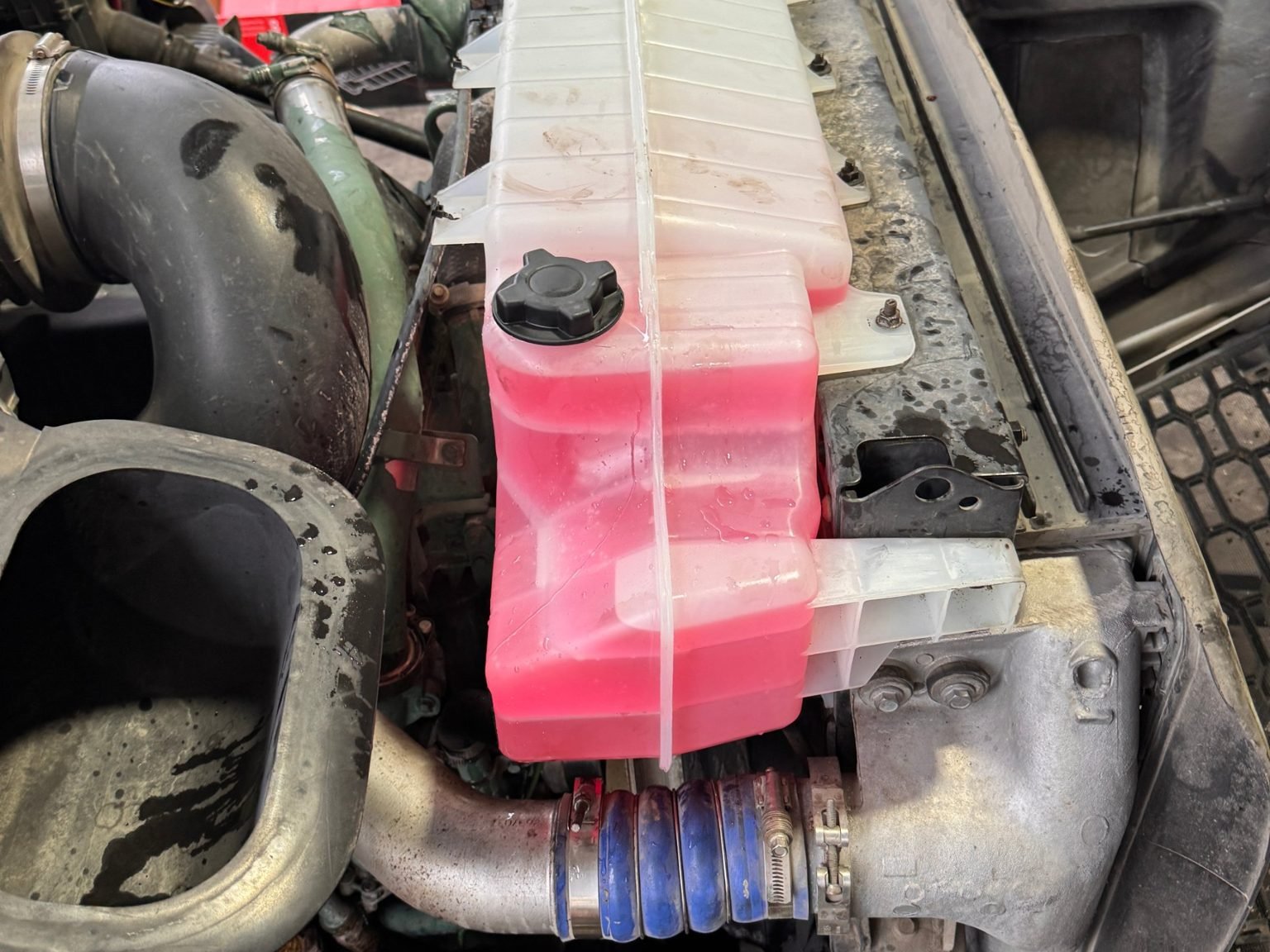
This is the most common cold-weather coolant problem we see on semis around Charlotte, and it is almost always self-inflicted. A truck runs a little low and someone tops off the overflow tank with water from the hose. Do that a few times over a summer and the antifreeze concentration drifts down without anyone noticing. Nothing on the dash tells you the freeze protection is gone.
If the mix is weak enough, coolant can freeze in the radiator, the lower hoses, or the block. Best case, the truck overheats on a cold morning because frozen coolant cannot circulate. Worst case, you split a radiator tank, push out a freeze plug, or crack the block or head. That turns a cheap coolant service into serious semi truck engine repair.
Wrong antifreeze type or mix
Heavy-duty engines are picky about coolant chemistry. Each engine maker specifies a coolant type, and mixing chemistries can cause gelling in the cooling system, corrosion, and clogged passages. If you do not know what is in the system, do not dump in whatever the truck stop has on the shelf. Match what the manufacturer calls for, at the concentration it calls for. Too little antifreeze and you lose freeze protection. Too much and the coolant transfers heat worse.
What weak or frozen coolant looks like from the seat
- Temperature gauge climbs on a cold morning even though it is freezing outside
- Heater blows cold or lukewarm when the engine should be warm
- Coolant looks rusty, muddy, or slushy in the overflow tank
- Low coolant or high coolant temperature warning on the dash
Fuel problems: gelled diesel and frozen water in the filters
Diesel fuel gelling
Diesel contains paraffin wax. When the fuel gets cold enough, the wax crystallizes and the fuel turns cloudy. Colder still, it binds into a gel that will not pass through the fuel filter. The engine starves, surges, loses power and stalls, usually on the highway right after the fuel sat cold in the tanks all night.
Fuel sold at Charlotte-area pumps is blended for the local climate, which is a problem when the local climate suddenly decides to act like Ohio.
Water in the fuel freezing in the separator
Every diesel picks up some water from condensation in the tanks, and the fuel-water separator is there to catch it. In a hard freeze, the water sitting in the separator bowl turns to ice, and ice blocks fuel flow just as well as gelled fuel. The symptoms are the same. The fix is not: a gelled truck needs the fuel treated and the filter changed, while a frozen-water truck needs the separator drained and the water source addressed, or it will do it again the next cold night.
What gelled fuel or a frozen separator looks like
- Cranks but will not start, or starts and dies after a few seconds
- Starts fine but surges and loses power under load
- Fuel pressure or fuel restriction warning
- Fuel in the separator bowl looks cloudy or has visible ice
A truck that will not run at daybreak and runs fine after a few hours in a heated bay was almost certainly gelled or iced, not broken. Getting it warm is the first step, not the fix.
A note on regens in cold weather
Aftertreatment needs exhaust heat to do its job, and cold air plus short trips means it takes longer to get there. Expect regens to take longer in a cold stretch, and expect a truck that sat cold overnight to need a good highway run to complete one. If the DPF warning stays on after a cold week, or the truck derates, that is a separate problem and worth a look at our DPF repair page.
Pre-winter checklist for Charlotte trucks
You do not need an arctic prep routine, just some attention before the first forecasted hard freeze.
- Test the coolant freeze point with a refractometer or test strips. Correct the mix if it is weak.
- Confirm the coolant type matches the engine manufacturer’s spec. If it has been topped off with unknown product, flush and refill.
- Inspect hoses, clamps and the overflow tank for cracks and seepage.
- Drain the fuel-water separator and check for water in the bowl.
- Replace fuel filters if they are anywhere close to due. A partly loaded filter gels first.
- Add a quality anti-gel additive before the cold, not after. Additives prevent gelling; most do not reverse it.
- Keep the tanks full to cut condensation, and fill with winter blend if you are running north.
- Test the block heater and cord if the truck has one.
- Load test the batteries. Cold cranking finds weak batteries fast.
If you run a fleet, this belongs on the fleet preventive maintenance schedule every fall, so every unit is done before the forecast turns.
What to do when it happens
If the truck will not start: do not keep cranking. You will flatten the batteries and gain nothing. A fuel problem needs heat and a filter change. A coolant problem needs to thaw slowly and be inspected before the truck runs.
If it loses power on the road: get off the lane as soon as you safely can. Gelled fuel gives little warning between surging and stopped.
If you see a coolant warning: shut it down. Overheating on a freezing day means the coolant is not moving, and more heat into a block with ice in it is the worst thing you can do.
For trucks stuck around Charlotte, Matthews or along I-485 and US-74, our mobile and roadside truck repair can come to you for fuel filter changes, separator service, anti-gel treatment and jump starts. Quick calls like a jump start have no labor minimum; repairs on a mobile call carry a 2-hour labor minimum. If the truck is drivable, bring it to the shop at 416 Seaboard Dr in Matthews, where shop labor is $100 per hour.
What we check in the shop
When a truck comes in after a cold-weather failure, we do not just thaw it and send it back out. A Charlotte cold snap usually lasts a few days.
- Coolant freeze point and concentration, measured, not eyeballed
- Coolant type against the engine spec, and whether chemistries have been mixed
- Cooling system pressure test for leaks that opened up in the cold
- Radiator, hoses, water pump, thermostat and freeze plugs for freeze damage
- Fuel filters and separator: drain, inspect for ice or wax, replace as needed
- Fuel sample from the tanks for cloudiness and water
- Fuel pressure and restriction under load after the filter service
- Battery load test and cable condition
- Block heater function, if equipped
- Fault codes pulled and cleared so you are not carrying a stale derate
Most of this is same-day work. If a part has to be ordered, we finish first thing the next business morning and confirm timing after the inspection. We work on Freightliner, Peterbilt, Kenworth, Volvo, Mack, International and Western Star, with dealer-genuine OEM parts.
Get ahead of the next freeze
A coolant test, a separator drain and a bottle of anti-gel in November cost a lot less than a cracked radiator in January. Book an appointment or call the shop before the forecast turns. For everything else we handle on heavy trucks and trailers, see truck repair in Charlotte, NC.
FAQ
Can semi truck coolant actually freeze in Charlotte?
Yes, if the antifreeze concentration is weak. Properly mixed coolant is protected well past anything Charlotte sees, but a system that has been topped off with water several times can freeze during one of the area’s occasional hard overnight freezes. The only way to know is to test the freeze point, not to assume it is fine.
What temperature does diesel fuel gel?
It depends on the fuel blend. Summer-blend diesel starts clouding and gelling at warmer temperatures than winter blend, and fuel pumped in a mild Charlotte fall is often summer blend. Rather than chase an exact number, treat the tanks with anti-gel before a forecasted hard freeze and keep fuel filters fresh.
Will an anti-gel additive fix fuel that has already gelled?
Usually not. Most additives are designed to prevent wax from binding up and do little once it has. A gelled truck typically needs heat to liquefy the fuel, a fuel filter change, and then treatment to keep it from happening again. Emergency de-gel products exist, but prevention is far more reliable.
How do I tell gelled fuel from a frozen fuel-water separator?
The symptoms are nearly identical: hard start, no start, loss of power, stall. Draining the separator bowl is the quickest way to tell. Ice or free water in the bowl points to a water problem; cloudy, waxy fuel points to gelling. Either way, get the truck warm and change the filter before diagnosing further.
Do you offer mobile service for a truck that gelled or froze overnight?
Yes. Our mobile and roadside service covers Charlotte, Matthews and the surrounding area for fuel filter changes, separator service, anti-gel treatment and jump starts. Quick calls like a jump start have no labor minimum. Repairs performed on a mobile call carry a 2-hour labor minimum. Call the shop to dispatch.